Retatrutide dosage calculator
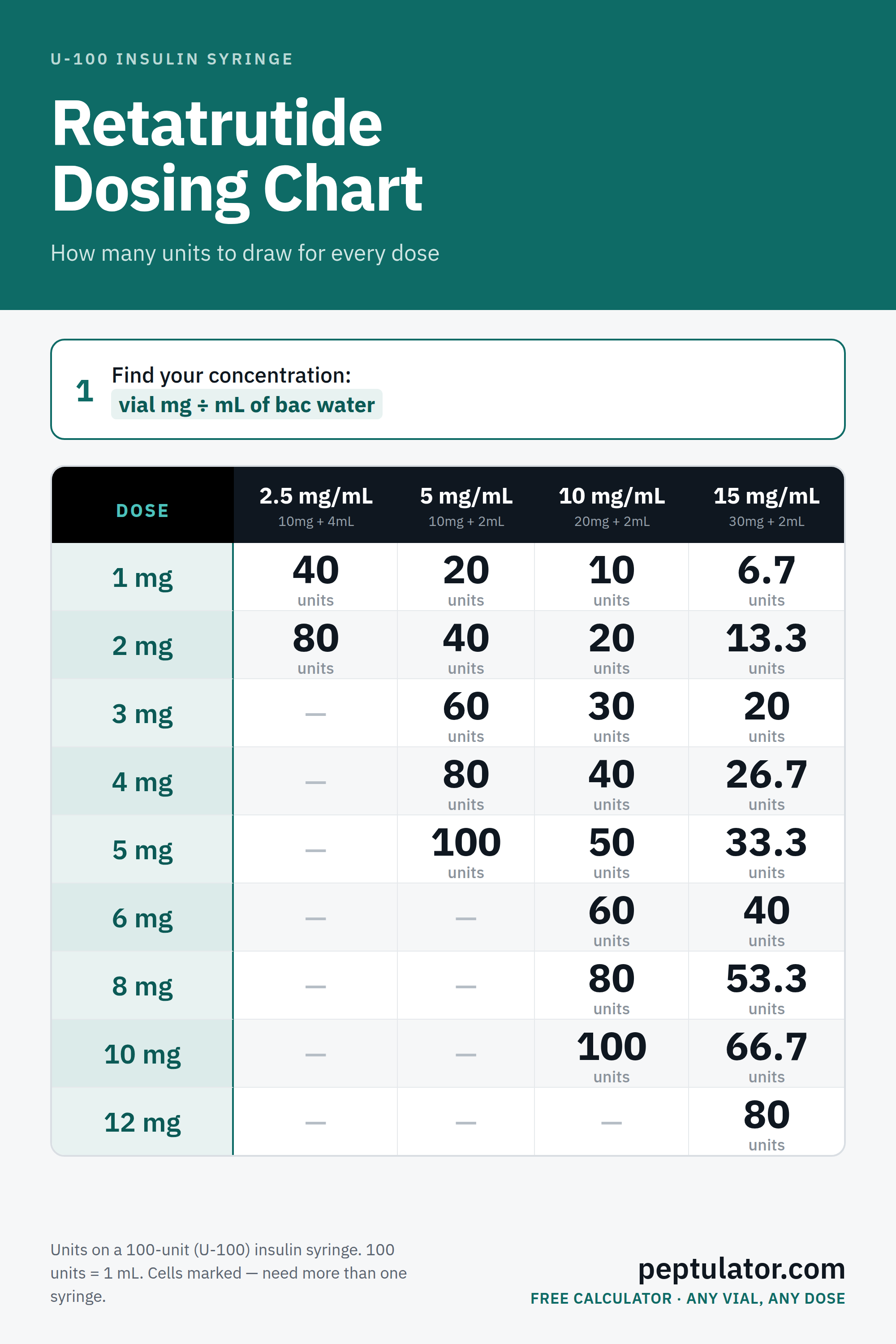
In a 10 mg vial with 2 mL of water (5 mg/mL), 2 mg of Retatrutide is 40 units on a U-100 insulin syringe. Retatrutide vials are usually 10 mg or 20 mg. Enter the vial strength, the water you added and your dose to get the unit mark to draw to.
25 printable pages: dosing cards for the twelve most-used compounds at three water volumes, titration planners, a vial log, and five pages on what to do when it has already gone wrong.
Dose to units at the usual vial and water
| Dose | U-100 units | Draw | Doses per vial | Vial lasts |
|---|---|---|---|---|
| 1 mg | 20 units | 0.2 mL | 10 | 70 days |
| 2 mg | 40 units | 0.4 mL | 5 | 35 days |
| 3 mg | 60 units | 0.6 mL | 3 | 21 days |
| 4 mg | 80 units | 0.8 mL | 2 | 14 days |
| 6 mg | 120 units | 1.2 mL | 1 | 7 days |
| 8 mg | 160 units | 1.6 mL | 1 | 7 days |
| 10 mg | 200 units | 2 mL | 1 | 7 days |
| 12 mg | 240 units | 2.4 mL | needs a bigger vial | - |
10 mg vial in 2 mL of bacteriostatic water (5 mg/mL), U-100 insulin syringe, once weekly.
About Retatrutide
Retatrutide is a triple agonist, acting on the GLP-1, GIP and glucagon receptors. It is an investigational compound. It has not been approved by any regulator, and material sold online is sold for laboratory research use rather than for human use.
Reported protocols generally start low and titrate every four weeks, which is why the table runs from 1 mg up to 12 mg. Where your own dose should sit is a question for a clinician, not for a calculator.
Retatrutide dosing chart: units for every vial and water volume
Every retatrutide dose used in the published trials (1, 2, 4, 8, 9 and 12 mg once weekly), plus the 6 and 10 mg steps many people use in between, converted to the mark on a U-100 insulin syringe for 5, 10, 15, 20 and 30 mg vials mixed with 1, 2 or 3 mL of bacteriostatic water. The concentration is what decides the units: 10 mg in 1 mL, 20 mg in 2 mL and 30 mg in 3 mL are all 10 mg/mL, so they give the same mark for the same dose.
5 mg vial
| Water | Concentration | 1 mg | 2 mg | 4 mg | 6 mg | 8 mg | 9 mg | 10 mg | 12 mg |
|---|---|---|---|---|---|---|---|---|---|
| 1 mL | 5 mg/mL | 20 units | 40 units | 80 units | more than the vial holds | more than the vial holds | more than the vial holds | more than the vial holds | more than the vial holds |
| 2 mL | 2.5 mg/mL | 40 units | 80 units | 160 units (over one 1 mL syringe) | more than the vial holds | more than the vial holds | more than the vial holds | more than the vial holds | more than the vial holds |
| 3 mL | 1.67 mg/mL | 60 units | 120 units (over one 1 mL syringe) | 240 units (over one 1 mL syringe) | more than the vial holds | more than the vial holds | more than the vial holds | more than the vial holds | more than the vial holds |
10 mg vial
| Water | Concentration | 1 mg | 2 mg | 4 mg | 6 mg | 8 mg | 9 mg | 10 mg | 12 mg |
|---|---|---|---|---|---|---|---|---|---|
| 1 mL | 10 mg/mL | 10 units | 20 units | 40 units | 60 units | 80 units | 90 units | 100 units | more than the vial holds |
| 2 mL | 5 mg/mL | 20 units | 40 units | 80 units | 120 units (over one 1 mL syringe) | 160 units (over one 1 mL syringe) | 180 units (over one 1 mL syringe) | 200 units (over one 1 mL syringe) | more than the vial holds |
| 3 mL | 3.33 mg/mL | 30 units | 60 units | 120 units (over one 1 mL syringe) | 180 units (over one 1 mL syringe) | 240 units (over one 1 mL syringe) | 270 units (over one 1 mL syringe) | 300 units (over one 1 mL syringe) | more than the vial holds |
15 mg vial
| Water | Concentration | 1 mg | 2 mg | 4 mg | 6 mg | 8 mg | 9 mg | 10 mg | 12 mg |
|---|---|---|---|---|---|---|---|---|---|
| 1 mL | 15 mg/mL | 6.7 units | 13.3 units | 26.7 units | 40 units | 53.3 units | 60 units | 66.7 units | 80 units |
| 2 mL | 7.5 mg/mL | 13.3 units | 26.7 units | 53.3 units | 80 units | 106.7 units (over one 1 mL syringe) | 120 units (over one 1 mL syringe) | 133.3 units (over one 1 mL syringe) | 160 units (over one 1 mL syringe) |
| 3 mL | 5 mg/mL | 20 units | 40 units | 80 units | 120 units (over one 1 mL syringe) | 160 units (over one 1 mL syringe) | 180 units (over one 1 mL syringe) | 200 units (over one 1 mL syringe) | 240 units (over one 1 mL syringe) |
20 mg vial
| Water | Concentration | 1 mg | 2 mg | 4 mg | 6 mg | 8 mg | 9 mg | 10 mg | 12 mg |
|---|---|---|---|---|---|---|---|---|---|
| 1 mL | 20 mg/mL | 5 units | 10 units | 20 units | 30 units | 40 units | 45 units | 50 units | 60 units |
| 2 mL | 10 mg/mL | 10 units | 20 units | 40 units | 60 units | 80 units | 90 units | 100 units | 120 units (over one 1 mL syringe) |
| 3 mL | 6.67 mg/mL | 15 units | 30 units | 60 units | 90 units | 120 units (over one 1 mL syringe) | 135 units (over one 1 mL syringe) | 150 units (over one 1 mL syringe) | 180 units (over one 1 mL syringe) |
30 mg vial
| Water | Concentration | 1 mg | 2 mg | 4 mg | 6 mg | 8 mg | 9 mg | 10 mg | 12 mg |
|---|---|---|---|---|---|---|---|---|---|
| 1 mL | 30 mg/mL | 3.3 units | 6.7 units | 13.3 units | 20 units | 26.7 units | 30 units | 33.3 units | 40 units |
| 2 mL | 15 mg/mL | 6.7 units | 13.3 units | 26.7 units | 40 units | 53.3 units | 60 units | 66.7 units | 80 units |
| 3 mL | 10 mg/mL | 10 units | 20 units | 40 units | 60 units | 80 units | 90 units | 100 units | 120 units (over one 1 mL syringe) |
Units on a standard U-100 insulin syringe, where 100 units is 1 mL. Units = dose in mg ÷ (vial mg ÷ water mL) × 100. "Over one 1 mL syringe" means the dose needs two draws, or less water so it fits in one. Always use the strength printed on your own vial.
Retatrutide dosing schedule from the trials
Retatrutide is an investigational compound, not an approved medicine, so there is no licensed schedule. What exists is the schedule the trials used. In the phase 2 obesity trial (Jastreboff et al., NEJM 2023), the 12 mg arm started at 2 mg once a week and stepped up every four weeks: 2 mg, then 4 mg, then 8 mg, then 12 mg from week 13 to week 48. The 4 mg and 8 mg arms started at 2 mg or 4 mg and stepped up the same way to their target, and the 1 mg arm stayed at 1 mg. The phase 3 TRIUMPH-1 trial also started everyone at 2 mg and stepped up every four weeks to a target of 4, 9 or 12 mg (Lilly, May 2026).
| Weeks | Weekly dose | 10 mg vial + 2 mL (5 mg/mL) | 30 mg vial + 3 mL (10 mg/mL) | 30 mg vial + 2 mL (15 mg/mL) | Total used so far |
|---|---|---|---|---|---|
| Weeks 1 to 4 | 2 mg once weekly | 40 units | 20 units | 13.3 units | 8 mg |
| Weeks 5 to 8 | 4 mg once weekly | 80 units | 40 units | 26.7 units | 24 mg |
| Weeks 9 to 12 | 8 mg once weekly | 160 units (over one 1 mL syringe) | 80 units | 53.3 units | 56 mg |
| Weeks 13 to 48 | 12 mg once weekly | more than the vial holds | 120 units (over one 1 mL syringe) | 80 units | 488 mg |
Phase 2, 12 mg arm. Units on a U-100 syringe. The 10 mg/mL column is the same for a 10 mg vial in 1 mL or a 20 mg vial in 2 mL.
Over the 48 weeks that arm used 488 mg, which is 49 vials of 10 mg or 17 vials of 30 mg, most of it in the 12 mg phase. At 10 mg/mL the four steps are 20, 40, 80 and 120 units; 12 mg is more than one 1 mL syringe at that strength, so mixing a 30 mg vial with 2 mL instead puts it at 80 units in one draw.
Weight loss by dose in those trials
| Weekly dose | Phase 2, 48 weeks | TRIUMPH-1, 80 weeks |
|---|---|---|
| 1 mg | 8.7% | not tested |
| 4 mg | 17.1% | 19.0% |
| 8 mg | 22.8% | not tested |
| 9 mg | not tested | 25.9% |
| 12 mg | 24.2% | 28.3% |
| Placebo | 2.1% | 2.2% |
Mean change in body weight. Phase 2: NEJM 2023 (the two 4 mg arms combined). TRIUMPH-1: efficacy estimand, which counts people as if they stayed on the drug (Lilly, May 2026); counting everyone randomised it was 25.0% on 12 mg against 3.9% on placebo (NEJM 2026). Trial results, not a recommendation for any dose.
How to use the retatrutide calculator
- Vial strength. Enter the milligrams printed on your vial (5, 10, 15, 20, 30 or 60 mg are the common sizes). Use your own label, not the product title.
- Water. Enter the millilitres of bacteriostatic water you added. The calculator divides the vial by the water to get the concentration.
- Dose. Enter your weekly dose in mg. The result is the volume in mL and the mark to draw to on a U-100 insulin syringe.
- Check the mark. If the result is over 100 units or under about 5, change the water so the dose lands somewhere you can read.
Worked example: a 30 mg vial with 3 mL of water is 10 mg/mL. A 4 mg dose is 4 ÷ 10 = 0.4 mL, which is 40 units. The same sum done by hand is in the methodology, and the titration schedule lays out a full 2 mg step ladder for your own vial.
Sources
- Jastreboff et al., Triple-hormone-receptor agonist retatrutide for obesity, a phase 2 trial, NEJM 2023. Arms 1, 4, 8 and 12 mg once weekly for 48 weeks, starting at 2 or 4 mg; mean weight loss by arm.
- Lilly: retatrutide TRIUMPH-1 topline results, May 2026. Start at 2 mg, up every four weeks to 4, 9 or 12 mg; 80 weeks; efficacy-estimand results.
- TRIUMPH-1, NEJM 2026. Peer-reviewed phase 3 results, treatment-regimen estimand.
The same 10 mg vial at other water volumes
If the draw is awkward to read, change the water, not the dose. The dose stays the same; only the mark moves.
| Vial | BAC water | Concentration | Draw | U-100 units | Doses/vial |
|---|---|---|---|---|---|
| 10 mg | 1 mL | 10 mg/mL | 0.2 mL | 20 units | 5 |
| 10 mg | 2 mL | 5 mg/mL | 0.4 mL | 40 units | 5 |
| 10 mg | 3 mL | 3.33 mg/mL | 0.6 mL | 60 units | 5 |
| 15 mg | 1 mL | 15 mg/mL | 0.133 mL | 13.3 units | 7 |
| 15 mg | 2 mL | 7.5 mg/mL | 0.267 mL | 26.7 units | 7 |
| 15 mg | 3 mL | 5 mg/mL | 0.4 mL | 40 units | 7 |
All rows above assume a 2 mg dose and a standard U-100 insulin syringe, where 100 units = 1 mL.
How long it lasts in the body
The half-life of Retatrutide is about 6 days. That is the time for the amount in your blood to halve, so after one half-life you are at 50 percent of the peak, after two you are at 25 percent, and after four you are at roughly 6 percent. This is why a weekly compound still has meaningful levels present when the next dose lands, and why levels build over the first several weeks before they settle.
Common questions
- How many units is 2 mg of Retatrutide?
- It depends entirely on how much water you added. In a 10 mg vial reconstituted with 2 mL, the concentration is 5 mg/mL, so 2 mg is 0.4 mL, which is 40 units on a U-100 insulin syringe. In the same vial with 1 mL of water it is 20 units, and with 3 mL it is 60 units.
- How much bacteriostatic water for a 10 mg Retatrutide vial?
- 2 mL is the usual choice. It gives 5 mg/mL, which puts the commonly reported range of 0.5 mg to 12 mg between roughly 10 and 240 units. Aim for a draw between about 10 and 50 units, where the barrel is easiest to read, and add or remove water to get there.
- How many doses are in a 10 mg vial?
- Divide 10 by your dose. At 2 mg that is 5 doses, which at once weekly is 35 days.
- Is retatrutide approved?
- No. It is investigational and not approved for human use. Material sold online is sold for research use only.
- What is the retatrutide dosing schedule?
- In the phase 2 trial (Jastreboff et al., NEJM 2023) the 12 mg arm took 2 mg once weekly in weeks 1 to 4, 4 mg in weeks 5 to 8, 8 mg in weeks 9 to 12 and 12 mg from week 13 to week 48. The phase 3 TRIUMPH-1 trial also started at 2 mg and stepped up every four weeks to 4, 9 or 12 mg. Retatrutide is not approved, so there is no licensed schedule.
- How many units is 4 mg of retatrutide?
- At 10 mg/mL (a 10 mg vial in 1 mL, a 20 mg vial in 2 mL or a 30 mg vial in 3 mL) it is 40 units on a U-100 syringe. At 5 mg/mL (a 10 mg vial in 2 mL) it is 80 units, and at 15 mg/mL (a 30 mg vial in 2 mL) it is 26.7 units.
- How many units is 12 mg of retatrutide?
- At 10 mg/mL it is 120 units, which is more than a 1 mL syringe holds, so it takes two draws. A 30 mg vial mixed with 2 mL (15 mg/mL) puts 12 mg at 80 units, and a 60 mg vial in 3 mL (20 mg/mL) at 60 units.
- What doses of retatrutide were tested in the trials?
- Phase 2 tested 1, 4, 8 and 12 mg once weekly for 48 weeks; mean weight loss was 8.7%, 17.1%, 22.8% and 24.2% against 2.1% on placebo. Phase 3 TRIUMPH-1 tested 4, 9 and 12 mg for 80 weeks; Lilly reported 19.0%, 25.9% and 28.3% against 2.2% on placebo.
Buying Retatrutide?
Peptulator does not list, rank or link vendors. Whoever the supplier is, use the strength printed on your own vial and check the batch certificate of analysis before you rely on any number here.
Common conversions
The same three-step maths, pre-filled for the doses people ask about most. Units on a U-100 insulin syringe, where 100 units is 1 mL.
- mg to units calculator Any dose at any concentration, both directions, with the full reference tables
- Units to mg calculator What the units you drew are in milligrams
- 1 mg to units The most-asked conversion, at every common setup
Related calculators and charts
Weight management (GLP-1 family)
- Retatrutide calculator (this page)
- Tirzepatide calculator The 2.5 to 15 mg ladder, converted
- Semaglutide calculator The 0.25 to 2.4 mg ladder, converted
- Cagrilintide calculator Amylin analogue, 0.3 to 4.5 mg weekly
Every one of the 27 compound calculators, charts and tools: the full list.