Peptide dosing chart and reconstitution chart (printable PDF)
Retatrutide, tirzepatide, semaglutide and the research peptides, each on one page, converted from vial strength and water volume into the mark to draw to.
Four one-page peptide dosing and reconstitution charts you can save to your phone, pin, or print and tape to the fridge. Each one turns a vial strength and a bacteriostatic water volume into the exact mark to draw to on a U-100 insulin syringe. They are static, so they cover the common setups; for any other combination the calculators do it live. Want all of them as one PDF, with dosing cards for the twelve most-used compounds and a vial log? That is the free Protocol Pack below.
25 printable pages: dosing cards for the twelve most-used compounds at three water volumes, titration planners, a vial log, and five pages on what to do when it has already gone wrong.
Peptide reconstitution chart: mg/mL and units per mg
Vial strength down the side, bacteriostatic water across the top. Each cell is the concentration you get, and how many units on a U-100 syringe one milligram takes at that concentration. For a dose, multiply: 0.25 mg from a 10 mg vial in 2 mL (5 mg/mL, 20 units per mg) is 0.25 x 20 = 5 units.
| Vial | + 1 mL water | + 2 mL water | + 3 mL water |
|---|---|---|---|
| 5 mg | 5 mg/mL 20 units per mg | 2.5 mg/mL 40 units per mg | 1.67 mg/mL 60 units per mg |
| 10 mg | 10 mg/mL 10 units per mg | 5 mg/mL 20 units per mg | 3.33 mg/mL 30 units per mg |
| 15 mg | 15 mg/mL 6.7 units per mg | 7.5 mg/mL 13.3 units per mg | 5 mg/mL 20 units per mg |
| 20 mg | 20 mg/mL 5 units per mg | 10 mg/mL 10 units per mg | 6.67 mg/mL 15 units per mg |
| 30 mg | 30 mg/mL 3.3 units per mg | 15 mg/mL 6.7 units per mg | 10 mg/mL 10 units per mg |
100 units = 1 mL on a U-100 insulin syringe. Doses in mcg: divide by 1,000 first. Want this and the dosing cards as a PDF? The free Protocol Pack above is 25 printable pages.
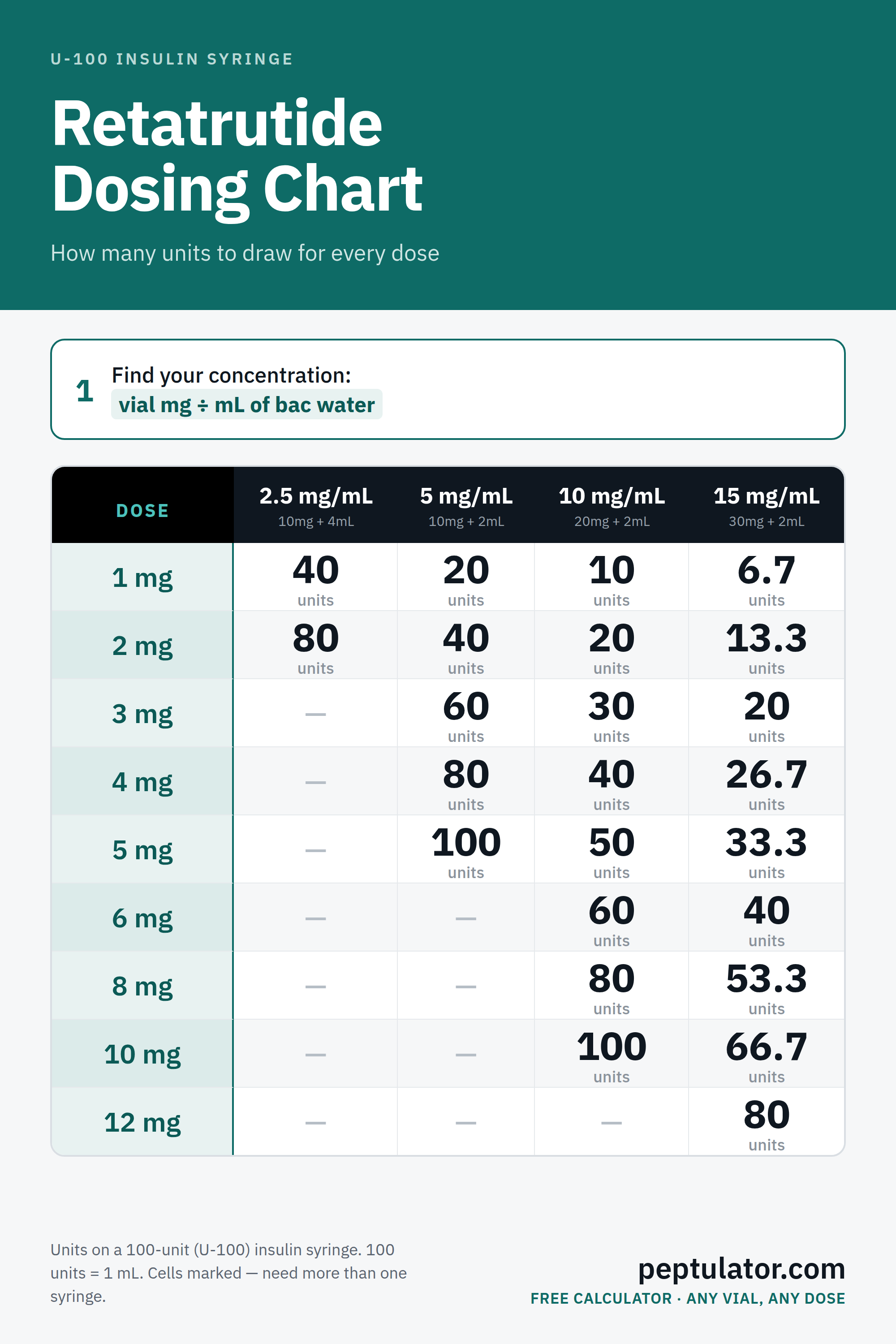
Retatrutide dosing chart
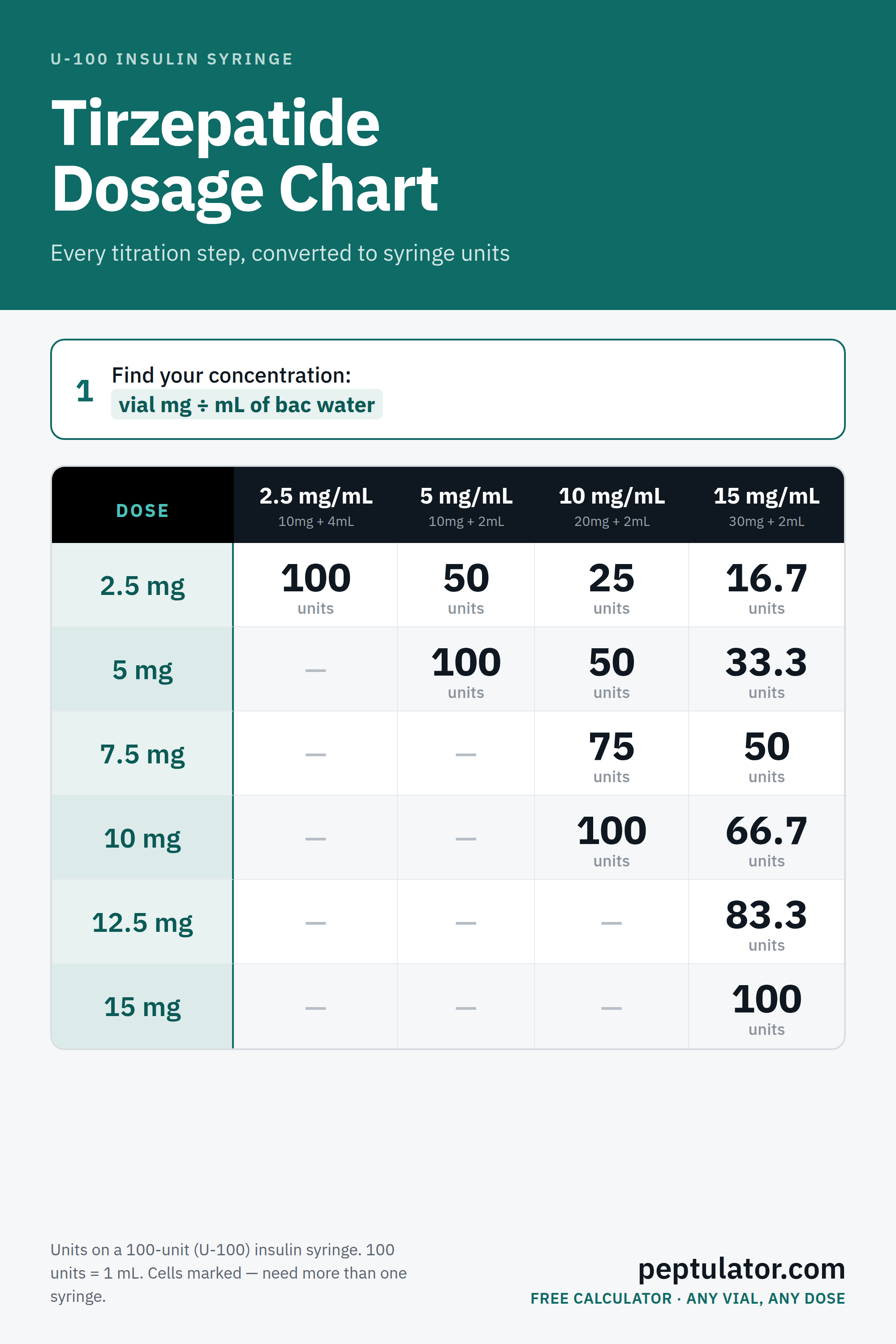
Tirzepatide dosage chart
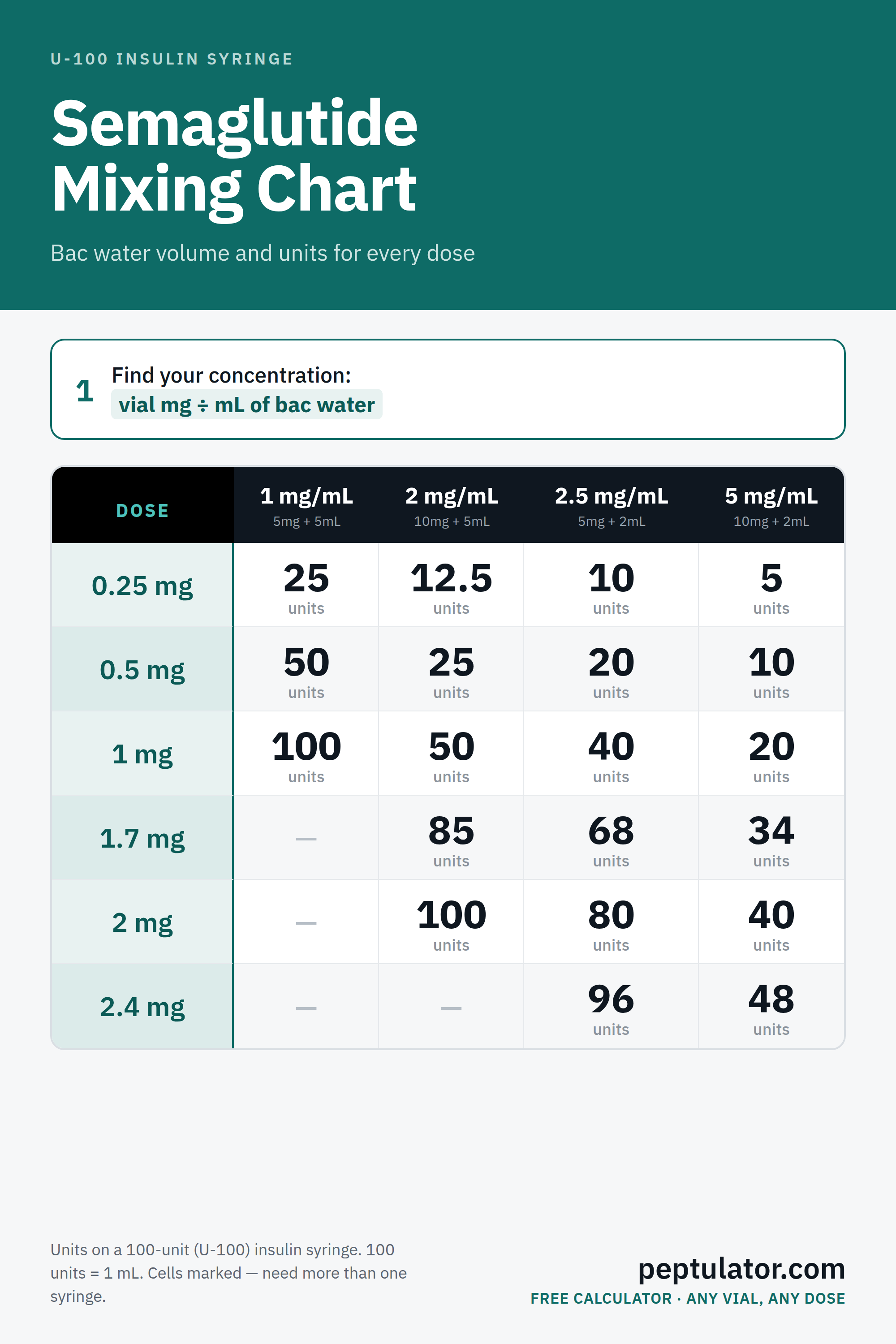
Semaglutide mixing chart
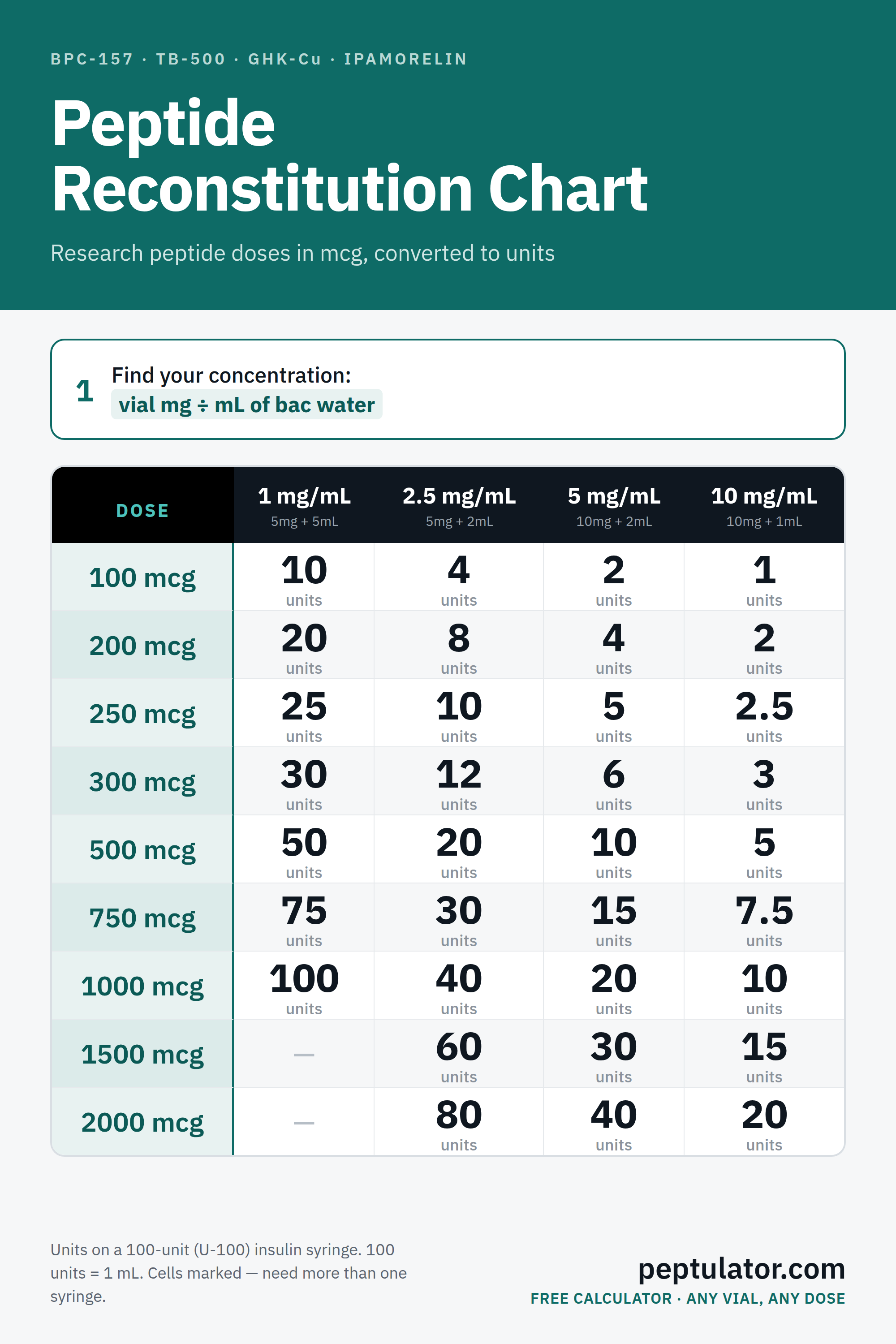
Peptide reconstitution chart
How to read any of them
Work out your concentration first: vial mg divided by the mL of bacteriostatic water you added. That is the column. Find your dose down the side. The cell is the number of units to draw. It works because a U-100 syringe holds 100 units in 1 mL, so a unit is always 0.01 mL no matter what is dissolved in it. Write the water volume on the vial in marker when you mix it, because the chart is useless a week later if you cannot remember which column you were in.
Common questions
- How many units is 2 mg of retatrutide?
- At 10 mg/mL, which is a 20 mg vial in 2 mL or a 10 mg vial in 1 mL, 2 mg is 20 units on a U-100 syringe. At 5 mg/mL it is 40 units.
- What water volume should I use?
- Whichever one puts your dose on a round number of units. For most retatrutide and tirzepatide vials that means mixing to 10 mg/mL, because then units is just the dose in mg times ten.
- How do I use the retatrutide chart for a 20 mg or 30 mg vial?
- Work out the concentration first: 20 mg in 2 mL is 10 mg/mL, 30 mg in 3 mL is 10 mg/mL and 30 mg in 2 mL is 15 mg/mL. Those are columns on the retatrutide chart. At 10 mg/mL a 2 mg dose is 20 units; at 15 mg/mL it is 13.3 units.
- Which chart is GLP-1, GLP-2 or GLP-3?
- Some vendors label semaglutide as GLP-1, tirzepatide as GLP-2 and retatrutide as GLP-3, so the semaglutide, tirzepatide and retatrutide charts are the ones to use. Check the compound name on the vendor certificate for your batch, because labels vary.
- Can I print these?
- Yes. Each chart has a download link for the full-size 1000 x 1500 image, which prints cleanly on a portrait A4 or Letter page.
Related calculators and charts
Dosage charts and schedules
- Peptide reconstitution chart Concentration for every vial and water combination
- Peptide dosing chart Printable unit tables for every compound
- Retatrutide titration schedule 2 to 12 mg in units, stage by stage
- Tirzepatide titration schedule 2.5 to 15 mg in units, stage by stage
- Semaglutide titration schedule 0.25 to 2.4 mg in units, stage by stage
- KLOW dosage and frequency chart The 80 mg blend at 2, 3 and 4 mL, both phases
- GLOW dosage chart The 70 mg blend, units to each peptide
- Wolverine stack dosing chart BPC-157 + TB-500, blend and separate vials
- MOTS-c dosage chart 5 and 10 mg vials at three water volumes
- Tirzepatide reconstitution chart Every vial size, every water volume, the whole ladder
- Tirzepatide units to mg chart Both directions, every vial and water volume
- Semaglutide units to mg chart The dosage chart in units, both directions
- NAD+ injection dosage chart Per day, per week and frequency, 100 to 1,000 mg vials
- Tesamorelin dosage chart 2, 5 and 10 mg vials, 0.5 to 2 mg in units
- BPC-157 dosage chart mcg doses from 5 and 10 mg vials, four water volumes
- PT-141 dosage chart The 10 mg vial, 0.5 to 2 mg, with uses per vial
- Sermorelin dosage chart Nightly mcg doses from 5, 10 and 15 mg vials
- Printable dosing charts (this page)
- Peptide storage chart How long powder and mixed vials last, fridge to freezer
Every one of the 27 compound calculators, charts and tools: the full list.